Wow! It's hard to believe that this will be the last time I will actually be graded on what I write on this blog (total bummer!). It is even harder to believe that never again will I have Mrs. Lewis as a teacher again. She is hands down the greatest English teacher I have ever had. There's something about those Lewis' that make them great teachers.... maybe it's the water at their house?
Seriously though! I can't believe this class is over. I always enjoyed coming to class bell 7 in the fall because it was always so relaxing and laid back. I can honestly say that some of my best poetry was written in that class because of how comfortable Mrs. Lewis made me feel, and how she forced all of us to work our hardest week in and week out. A class such as poetry can be very hands on. Although it is nice to have somebody who is overseeing throughout the entire process, what made the class so rewarding to me was the fact that Mrs. Lewis was reluctant at first to give away the answer to making a poem "better". She wanted our class to think critically, which is what learning is all about!
In terms of the class itself and the subject matter, it was flawless. Each poet we studied was hand-picked, and each poet has a special prose which we studied. I thought it was especially useful studying these poets, because their proses carried over into my poetry prose, therefore making my poetry more structured. Also, Mrs. Lewis was very generous and understanding with deadlines, which made this class AMAZING! God, I wish every teacher was like her in terms of flexibility.
There really is not much for me to write. I could write story after story on how wonderful our class was. Mrs. Lewis knew exactly when to cheer us up if we were sad, and most importantly, she knew exactly when we needed a break throughout the term. Although I will move onto a completely different English class next term, I will keep all of vocabulary, knowledge, and cheeriness Mrs. Lewis gave me every bell 7. She will be missed, but never forgotten. I will be in the library frequently. Thank you for everything Mrs. Lewis. =D
Sunday, November 14, 2010

Evolution of Hip Hop

Throughout African-American history, African Americans have overcome adversity on multiple occasions, but rather than violently protesting, they have often sent their messages and demands through music. By doing so, multiple genres and record labels have become prosperous. Hip Hop music may be arguably the most political and educational genre, in terms of its lyrics, at the end of the twentieth century. The birth of modern Hip Hop music in the early 1980s was a direct result of the literary movement spawned by the Black Power movement who emphasized racial pride, education, and political awareness.

 Previous genres of African-American music, similar to Hip Hop, directly showed how African Americans were living. Three movements in American history from the 1920’s through the 1970’s gave birth to three new genres of music. Jazz Music was formed as a result of the Harlem Renaissance. During the Civil Rights era, a record label, Motown, brought new artists, and nearly all of these artists became music legends, such as Michael Jackson, Stevie Wonder and Marvin Gaye. A generation later, New York artists began to shift away from Motown and began to MC, a new form of mixing, and “free styling”. In New York City, in parts of Brooklyn and Harlem, new forms of music began, known as DJ-ing and MC-ing. Both of these types of music are elements of modern Hip Hop; they too, like jazz, directly showed African Americans’ political awareness. When many African Americans look back on the 1970's and 80's, music and literature helped unite the African American Race. With the Civil Rights movement ending, African Americans no longer accepted any form of limitation because of their skin color.

In the 1970’s and 80’s, Sugar Hill Records, a New Jersey label that helped propel rap to a mass-market acclaim, helped give rap music a regional sound. One of the most influential artists who was a part of Sugar Hill Records was Grandmaster Flash; he released a song, “The Message” (1982), to show how his poverty stricken town is “like a jungle sometimes.” He first describes the stairs and floors of his apartment having, “broken glass everywhere,” and how “people pissin’ on the stairs / you know they just don’t care.” He then explains his situation, having “no money to move out / I [Grandmaster Flash] guess I have no choice,” even though he has “rats in the front room, roaches in the back [and] / junkies in the ally with a baseball bat." Later on in the day, his son comes home from school, wanting to drop out, because his “teacher’s a jerk / he must think I’m a fool / and all the kids smoke reefer, [so] / I think it’d be cheaper if I just got a job / learned to be a street sweeper.” From these lyrics, it is obvious that an average African American’s home life is both stressful, and inflexible. All of these forms of music were all incorporated into later Hip Hop, and modern Hip Hop today. Through later movements, the evolution of newer Hip Hop was inspired.
Rap’s later political influences were the Black Power Movement and post-Civil Rights movements. These movements had an impact on African Americans ranging from Afro’s to voting. Some of these political movements are still active today. Through their actions, leaders, and inspirations from the leaders, the Black Power Movement had a large influence in later Hip Hop.
Tuesday, November 2, 2010
Giovanni + Baraka= Black Arts
What is the Black Arts movement? As Time Magazine stated, The Black Arts Movement is a single, most controversial moment in the history of African-American literature--possible in American literature as a whole". It was basically to encourage black pride and to seperate black idealogies to strengthen black culture, creativity and education. It voiced black thoughts. It all began in Harlem, New York in 1965 and it last for about ten years. The Black Arts Movement was also called the "sixties" movement. After the assassination of Malcolm X in 1965, a famous black artist named LeRoi Jones later known as Amiri Baraka moved to Harlem. Baraka was the most respected black publisher writer in the history of Poetry. Although his poems were centered around African American culture and the Black Power movement, at the same time, he still inspired many white poets because he took words and emotions and created intelligent and genius poems. One of his most famous poems, which we studied in our Contemporary Poetry class studied was "In Memory of Radio", however the poem is not about radio. Baraka uses subjects in this poem to depict many idead throughout society like techinology, imagination and imagination. This poem is written in free verse in which Baraka evokes a sense of loss and nostalgia. The main image Baraka uses is the superhero, "The Shadow", under the cloak of invisibility to hunt down the worlds evil. Although Baraka's work was centered around the Black Arts, his earlier work was influenced by the Beat Movement and Beat writers such as Kerouac (as he mentioned in his poem). The Beat movement challeneged everything that was considered "right" such as the middle class, the popular suburban white culture and the government. 

Another signature Black Arts Movement poet was Nikki Giovanni, a strong supporter of the Black Arts and the rights and freedom of women who inspired many African Americans and women. She begins the poem "Ego Tripping" with the line "I was born in the Congo", which gives us an idea that she is black. She is basically saying that this is who I am. I am black, I am a woman. What is interesting and inspiring about this poem is that she compares herself to Allah and Jesus, like a Supernatural being. She puts herself on the level of God, stating that there is no difference between her and God, she is as special as God. Giovanni shows that she is perfect, unique and special, one of the main themes of the Black Arts Movement, that blacks ARE special and unique. She ends the poem with "I mean...I can fly like a bird in the sky...". This last line emphasizes the freedom of blacks and women. That everyone has the capability to fly and be free from no restrictions, that there are possibilities for everyone.
Wow! It matters THAT much....
This week in poetry class, we read Amiri Baraka's poem, "In Memory of Radio." First off, this poem was absolutely awesome, because it brings up a very accurate point about the changes in society in mid-twentieth century America. He writes, "What can I say? / It is better to haved loved and lost /Than to put linoleum in your living rooms?," trying to denigrate the new ideals of a new America. Another reason why I loved his poem so much is because he uses radio program titles of shows he probably watched as a child to show how these shows affected his morals and maturation process. That concept made me think, how did media affect me growing up? In response to this question, I wrote a poem:

 Knowing that some television shows are not suitable for children, the FCC created a Parental Ratings system for Television programs. As the level of the rating increases, the suggested audience becomes more selective. However, disobedient children, as well as naive parents oftentimes do not follow these ratings, which in the end strongly affects a child's development process.
 Statistic show that a fair majority of a child's discipline issues or problems have a direct correlation with either his or her home life, or what he or she is exposed to from the media. Multiple parents have recognized this statistic, so parents purchase parental control tools, allowing them to block television programs that they do not want their children to see. Do I think this is effective? Yes. Frankly, I think every parent should have this technology on their televisions, but unfortunately, not all parents are good parents. On a recent interview with 60 Minutes, famous rap star Eminem briefly speaks about his opinion on parenting. Obviously, a lot of material in Eminem's songs are very intense and vulgar. However, he told Anderson Cooper that he uses that language to only sell records. “I’m a parent. I have daughters. I mean, how would I really sound as a person … walking around my house [saying] ‘Bitch, pick this up,’ you know what I mean? … I don’t cuss,” he told Cooper. “Profanity around my house? No,” Eminem adds. “I’m not saying there’s not glimpses of me in the music, [that] there’s not truth in … things that I say,” the rapper says. “But this music, this is my art.” The climax of the interview was when Cooper asked the rap star if he feels any sort of responsibility for younger children listening to his explicit songs. Not only does he feel no responsibility whatsoever, he also rebutted, “I feel like it’s your [a parent's] job to parent them. If you’re the parent, be a parent.” The world needed to hear that kind of comment from somebody, because I think that the world needs to make steps in the right direction to solve this cyclical dilemma of exposing graphic and profane materials to children. Who is there to blame?
Additional Links / Videos
http://www.tvguidelines.org/index.htm
http://allpsych.com/journal/violentmedia.html
http://www.associatedcontent.com/article/16514/the_effects_of_media_on_children.html?cat=25
http://pediatrics.aappublications.org/cgi/content/abstract/125/4/756
http://www.medscape.com/viewarticle/448017_2
http://www.dailymail.co.uk/health/article-491796/Televison-violence-tied-young-boys-aggression.html
Whether it was Arthur or WWE,
My butt never left the couch.
Every show, every commercial meant something to me.
The use of body language to show excitement, disappointment,
Even promiscuity.
Learning special words such as ‘superiority,’ ‘incognito,’
Even osculation.
I absorbed it all like a sponge.
A sponge in the Sahara,
Thirsting for any form of moisture.
For those who now say that television is useless,
Look back then.
Veggie Tales, Little Bear, Full House.
Now a days what is there?
Late night HBO?
This concept also interested me to research it on a larger level. According to the Kaiser Family Foundation (KFF):
- two-thirds of infants and toddlers watch a screen an average of 2 hours a day
- kids under age 6 watch an average of about 2 hours of screen media a day, primarily TV and videos or DVDs
- kids and teens 8 to 18 years spend nearly 4 hours a day in front of a TV screen and almost 2 additional hours on the computer (outside of schoolwork) and playing video games

Now, television is not all bad for children. Television channels including the Discovery Channel, The History Channel, Disney Channel, Nickelodeon, and PBS have all been considered "educational." Unfortunately, children watch more than these limited channels, making children react in the following manners:
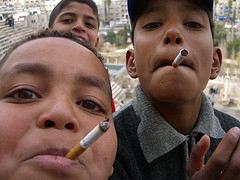
- Kids who view violent acts are more likely to show aggressive behavior but also fear that the world is scary and that something bad will happen to them.
- Kids who watch TV characters who often depict risky behaviors, such as smoking and drinking, and also reinforce gender-role and racial stereotypes often reenact these behaviors.

 Statistic show that a fair majority of a child's discipline issues or problems have a direct correlation with either his or her home life, or what he or she is exposed to from the media. Multiple parents have recognized this statistic, so parents purchase parental control tools, allowing them to block television programs that they do not want their children to see. Do I think this is effective? Yes. Frankly, I think every parent should have this technology on their televisions, but unfortunately, not all parents are good parents. On a recent interview with 60 Minutes, famous rap star Eminem briefly speaks about his opinion on parenting. Obviously, a lot of material in Eminem's songs are very intense and vulgar. However, he told Anderson Cooper that he uses that language to only sell records. “I’m a parent. I have daughters. I mean, how would I really sound as a person … walking around my house [saying] ‘Bitch, pick this up,’ you know what I mean? … I don’t cuss,” he told Cooper. “Profanity around my house? No,” Eminem adds. “I’m not saying there’s not glimpses of me in the music, [that] there’s not truth in … things that I say,” the rapper says. “But this music, this is my art.” The climax of the interview was when Cooper asked the rap star if he feels any sort of responsibility for younger children listening to his explicit songs. Not only does he feel no responsibility whatsoever, he also rebutted, “I feel like it’s your [a parent's] job to parent them. If you’re the parent, be a parent.” The world needed to hear that kind of comment from somebody, because I think that the world needs to make steps in the right direction to solve this cyclical dilemma of exposing graphic and profane materials to children. Who is there to blame?
Additional Links / Videos
http://www.tvguidelines.org/index.htm
http://allpsych.com/journal/violentmedia.html
http://www.associatedcontent.com/article/16514/the_effects_of_media_on_children.html?cat=25
http://pediatrics.aappublications.org/cgi/content/abstract/125/4/756
http://www.medscape.com/viewarticle/448017_2
http://www.dailymail.co.uk/health/article-491796/Televison-violence-tied-young-boys-aggression.html
Monday, October 25, 2010
Knight saved the day?
 This week in poetry class, we learned about one of my favorite poets, Etheridge Knight. One of the main reasons I really love his poetry is because even though he dropped out of school at such a young age (16, in fact) he was still a poetic genius. He was born in Corinth, Mississippi, in 1931, and was given honors from the Guggenheim Foundation, the National Endowment for the Arts, and the Poetry Society of America.
Luckily, we got to read my favorite poem by Knight, "The Idea of Ancestry," in class this week. The poem itself reads:
1
Taped to the wall of my cell are 47 pictures: 47 black
faces: my father, mother, grandmothers (1 dead), grand-
fathers (both dead), brothers, sisters, uncles, aunts,
cousins (1st and 2nd), nieces, and nephews. They stare
across the space at me sprawling on my bunk. I know
their dark eyes, they know mine. I know their style,
 they know mine. I am all of them, they are all of me;
they are farmers, I am a thief, I am me, they are thee.
I have at one time or another been in love with my mother,
1 grandmother, 2 sisters, 2 aunts (1 went to the asylum),
and 5 cousins. I am now in love with a 7-yr-old niece
(she sends me letters in large block print, and
her picture is the only one that smiles at me).
I have the same name as 1 grandfather, 3 cousins, 3 nephews,
and 1 uncle. The uncle disappeared when he was 15, just took
off and caught a freight (they say). He's discussed each year
when the family has a reunion, he causes uneasiness in
the clan, he is an empty space. My father's mother, who is 93
and who keeps the Family Bible with everbody's birth dates
(and death dates) in it, always mentions him. There is no
place in her Bible for "whereabouts unknown."
2
Each fall the graves of my grandfathers call me, the brown
hills and red gullies of mississippi send out their electric
messages, galvanizing my genes. Last yr/like a salmon quitting
the cold ocean-leaping and bucking up his birth stream/I
hitchhiked my way from LA with 16 caps in my pocket and a
monkey on my back. And I almost kicked it with the kinfolks.
I walked barefooted in my grandmother's backyard/I smelled the
old
land and the woods/I sipped cornwhiskey from fruit jars with the
men/
I flirted with the women/I had a ball till the caps ran out
and my habit came down. That night I looked at my grandmother
and split/my guts were screaming for junk/but I was almost
contented/I had almost caught up with me.
(The next day in Memphis I cracked a croaker's crib for a fix.)
This yr there is a gray stone wall damming my stream, and when
the falling leaves stir my genes, I pace my cell or flop on my bunk
and stare at 47 black faces across the space. I am all of them,
they are all of me, I am me, they are thee, and I have no children
to float in the space between.
Overall, in the first section of the poem, Knight is describing a setting where he is sitting in his jail cell staring at all of these pictures of his relatives on the wall. He looks at these pictures very often, and he reminds himself that no matter how successful a person if with or without the help of their families, they still are a part of the family. He even comments on one of his uncles, whose “whereabouts [are] unknown"; regardless of whether the uncle wants to admit it or not, he is part of the family and there is nothing that can change that fact.
In the second section of the poem, Knight describes his reckless behaviors from when he was young; these events were probably the culmination of him going to jail. In one night he manages to “walk barefooted in my grandmother’s backyard/ smell the old land and the woods/ sip cornwhiskey from fruit jars with the men / flirt with women.” After all of these actions were done, he was forced to see his grandmother, and he was full of aberration and shame, he could not even face her.
this poem reach out to individual families, but Knight was also trying to reach out to the African American community at large. Larry Neal, a famous poetry critic, said in response to this poem that, "Black Arts is the aesthetic and spiritual sister of the Black Power concept. As such, it envisions art that speaks directly to the needs and aspirations of Black America." Knight supports the Black Arts movement throughout the poem, because he describes his family, as well as the African American family as “dead . . . living . . . [and] unborn,” recognizing that he still has commitments to his family. Finally, he also addresses the Black Arts Movement and his family at the end of the poem by assuring to both of them, "[he is] all of them / they are all of [him], [he is himself], they are thee.
 This concept of continuity between African Americans during this period is what really led to having an African American flourishing community. Many other poets too followed this avenue, and ultimately, African Americans benefitted tremendously. Another prime example is Gwendolyn Brooks. In her poem "We Real Cool," overall she wanted to persuade people to stay in school, and think before a person (specifically an African American) acts. During the Early and Middle Twentieth century, there was a lot of crime and depression in urban areas across the United States. In order not to starve, many adults and teenagers hit the streets in order to make any money they could. Keeping this in mind, Brooks is trying to forward to her readers that although it may be satisfying and fun at the moment to be reckless and miss out on school, education is the most important part of any young man or lady's life. Through all of these positive messages sent to the upcoming generations, African Americans began speaking out and saying, "'We, the people'is a very eloquent beginning. But when that document [the Preamble to the US Constitution] was completed on the seventeenth of September in 1787 I was not included in that 'We, the people.' I felt somehow for many years that George Washington and Alexander Hamilton, just left me out by mistake. But through the process of amendment, interpretation and court decision I was finally included in 'We, the people.'"[Barbara C. Jordan 1974].
If it were not for the Black Arts Movement, and scores of poets preaching positive messages to stay together and peacefully protest to gain equality among all men and women, who knows what the United States of America would be like today.
Sunday, October 24, 2010
SHORTEST???
Last week in my poetry class, we learnt a poem from Gwendolyn Brooks, "We Real Cool." I think it is the shortest poem we have leanrt in class. "We Real Cool" only has eight lines and each line only has three words, but it gives readers much space to imagine--late afternoon, kids skip school, hang out at the pool and think they are really cool.

We real cool. We
Left school. We
Lurk late. We
Strike straight. We
Sing sin. We
Thin gin. We
Jazz June. We
Die soon.
We also did an interesting activity in my poetry class called "boil the poem"--everyone picked a poem he or she wrote and tried to shorten it. The poem of Brooks and the activity we did in class made me wonder--what is the shortest poem in the world?
"Lines on the Antiquity of Microbes", also known simply as "Fleas", is a couplet commonly cited as the shortest documented poem ever written with an unknown author. It is easy to remember because of its perky rhyme, humorous and allusion. Here is the poem:
Fleas
Adam
Had 'em
Some people think "Fleas" should not be the shortest poem because it has two words, but I wonder if one word will still be recognized as a poem. Poems can be as long as an article, or as short as a word. I think long poems can give readers an image of the theme easily and the short poems develop people's imagination. Short poems can actually be harder to write than long poems because authors have to use the least amount of words to express the most thought. I prefer to read short poems and guess what is going on when everything is not obvious.

We real cool. We
Left school. We
Lurk late. We
Strike straight. We
Sing sin. We
Thin gin. We
Jazz June. We
Die soon.
We also did an interesting activity in my poetry class called "boil the poem"--everyone picked a poem he or she wrote and tried to shorten it. The poem of Brooks and the activity we did in class made me wonder--what is the shortest poem in the world?
"Lines on the Antiquity of Microbes", also known simply as "Fleas", is a couplet commonly cited as the shortest documented poem ever written with an unknown author. It is easy to remember because of its perky rhyme, humorous and allusion. Here is the poem:

Fleas
Adam
Had 'em
Some people think "Fleas" should not be the shortest poem because it has two words, but I wonder if one word will still be recognized as a poem. Poems can be as long as an article, or as short as a word. I think long poems can give readers an image of the theme easily and the short poems develop people's imagination. Short poems can actually be harder to write than long poems because authors have to use the least amount of words to express the most thought. I prefer to read short poems and guess what is going on when everything is not obvious.
Here is a link of another two-word short poem "Me, We" from Muhammad Ali.
WHERE IS THE HARLEM NEIGHBORHOOD RIGHT NOW???
 Last weekend, I went to New York City. I was staying at my friends' house on 77th street. It was great to spend a long weekend at New York City and meet some old friends. Monday afternoon, I was thinking about what I did in the past weekend on the bus back to school; a word suddenly appeared in my mind--"Harlem." I learnt Harlem Renaissance from my poetry class and read many poems from poets in this period, such as Langston Hughes. "Why didn't I go there???!!!" Maybe I had too much fun. But I want to go there and see how the neighborhood looks like right now.


The Harlem Renaissance was a cultural movement that spanned the 1920s and 1930s, it was also known as the "Negro Movement." It was centered in the Harlem Neighborhood in th New York City ( which starts at 125th street, between Madison Avenue and Park Avenue, Manhattan). As we know the golden age of Harlem Neighborhood was about 1920s--1930s because it was the black culture center at that time, but the neighborhood has been there since 17th century. The hard economic times hit Harlem during the Depression with poverty, high unemployment and high crime rates. After the 1980s, the was a huge redevelpment in the neighborhood. As the Manhattan real estate market boomed, the abandoned buildings in Harlem were replaced with new housing and office buildings. Soon many shops and restaurants moved in, some people call it Harlem’s second renaissance became official.
 It seems like the Harlem Neighborhood looks totally different right now from the pictures and the articles I read, but I still want to visit there. Most of the buildings might disappeared already, but the Harlem Renaissance is memorized in people's hearts.
Some extra information about Harlem Renaissance:
http://en.wikipedia.org/wiki/Cotton_Club_(New_York_City)
http://www.biography.com/blackhistory/harlem-renaissance.jsp
Subscribe to:
Posts (Atom)